4 Summer Bedding Ideas for Summer Nights
It's 2am and you've kicked the duvet off for the third time this week. The fan is on, the window is open, and somehow the sheets still feel warm.
If this sounds familiar, your bedding might be the problem. The layers that make your bed feel wonderfully cocooning in winter can become a little too good at their job once the temperature climbs.
When summer arrives, your bed needs a rethink. Not a complete overhaul, but just a few smarter swaps that help you stay comfortable when the nights refuse to cool down.
These summer bedding ideas will help you sleep lighter and breathe easier, even when the weather has other plans.
The science of sleep: Why your bed temperature matters
Your body naturally cools down as you fall asleep. If your bedding traps too much heat or moisture against your skin, it can make that process harder and leave you feeling hot, restless, and generally over the whole sleeping thing.
That’s why bedding for summer should do less. Lightweight layers, breathable fabrics, and a little flexibility can help regulate how warm your bed feels throughout the night.
Think of your summer bedding like your wardrobe. You wouldn’t wear a wool coat to bed in summer, so why expect a winter-weight duvet to suddenly behave itself?
The good news is that you don’t need to replace everything. A few considered changes can make your bed feel noticeably cooler and more comfortable.

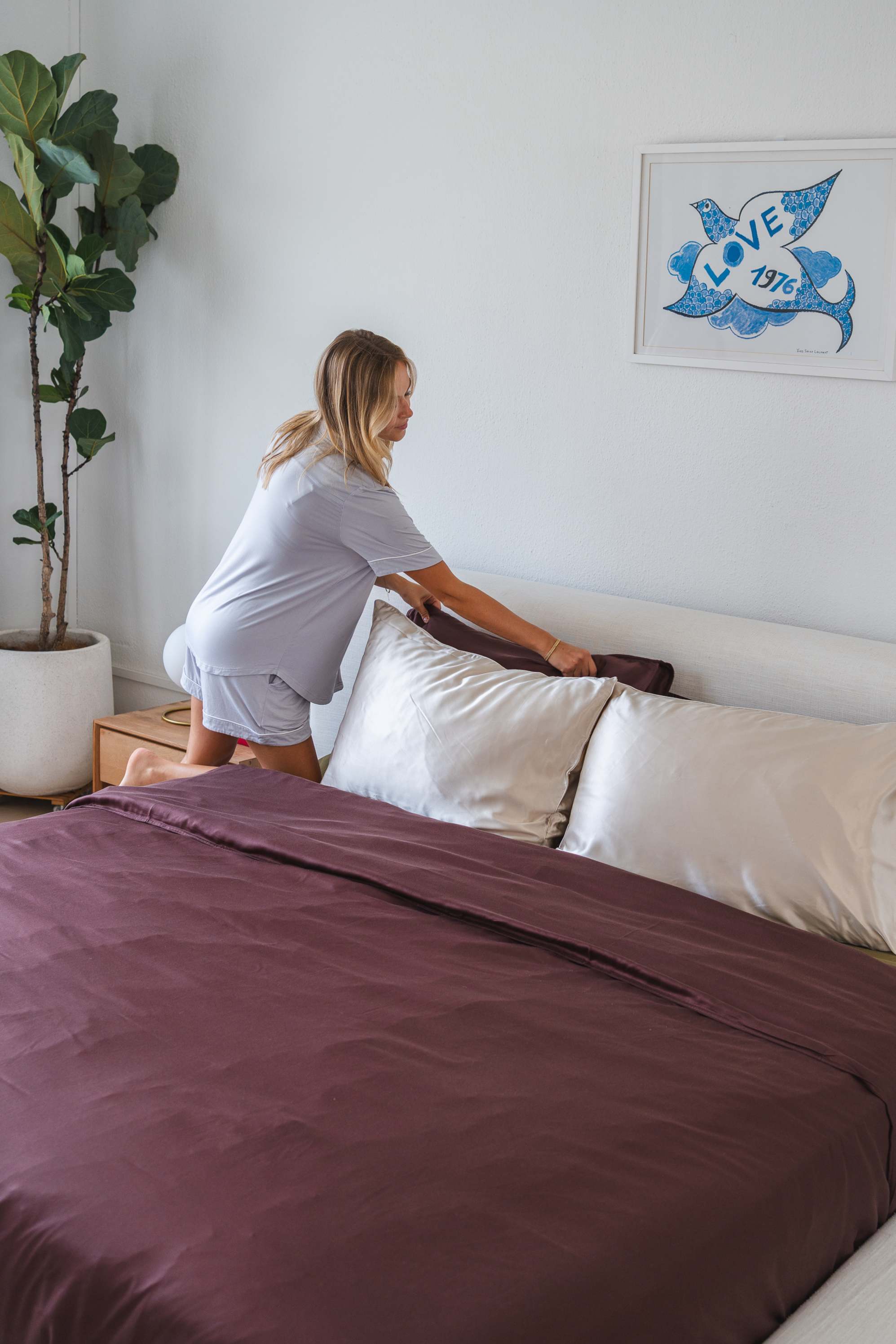
The Dawson Storage Bed.
Photo credits: @becca_maree__
The Dawson Storage Bed.
Photo credits: @becca_maree__

4 bedding ideas for a cooler, more comfortable bed
1. Swap the heavy duvet for lightweight bedding
A lightweight cover, a coverlet, or a single flat sheet does the job without smothering you. When you sleep in on Saturday, and the sun has already turned the room into a slow oven, you'll thank your bedding.
2. Choose breathable fabrics that let you sleep cool
When choosing the best sheets for summer, look for natural, breathable fabrics with a comfortable, lightweight feel.
Cotton is a classic for good reason. It’s breathable, soft, and easy to live with, particularly in a crisp percale weave.
Linen has a naturally airy feel and that slightly relaxed texture that only gets better with time.
TENCEL™ Lyocell is soft, smooth, and breathable, with a moisture-managing feel that makes it a comfortable choice for warmer nights.
Lightweight weaves generally allow more airflow than dense, heavy fabrics, making them a smart choice for warm nights.
Synthetic or heavily treated fabrics can feel warmer when they don’t allow heat and moisture to escape as easily.
Thread count can be useful, but don’t let a bigger number automatically win you over. A very high thread count can mean a denser weave, which isn’t necessarily what you want when the bedroom feels like a sauna.
And don’t forget what’s underneath all those layers. If you’re still waking up hot despite switching to lighter summer bedding, your mattress could be part of the equation too. A cooling gel memory foam mattress (like our Ayrie Mattress) can be worth considering if you want to rethink your sleep setup from the bottom up, not just swap what’s on top.

The Ayrie Comfort Mattress
Photo credits: @bobmubarak
The Ayrie Comfort Mattress
Photo credits: @bobmubarak

3. Adopt a light layering system
Heavy layering belongs to winter. Summer layering is about giving yourself options without piling on warmth.
The trick is to think in flat layers, not bulk. A breathable sheet, a thin coverlet folded at the foot of the bed, an accent throw within reach for when the AC kicks in. You can pull pieces on and off through the night without ever fully committing to a duvet.
Here's how to layer a bed for summer without overdoing it:
Start with a fitted sheet in cotton or linen as the foundation.
Add a flat sheet on top, which doubles as a light cover on warmer nights.
Layer a lightweight coverlet folded at the foot, depending on the size of your bed.
Keep one accent throw within arm's reach for the moments when the AC overcorrects.
Finish with a silk pillowcase for a smooth, breathable layer that helps keep your sleep setup feeling comfortable through the night.
4. Update your colour palette
Dark bedding absorbs heat through the day, especially if your bedroom catches afternoon sun. By the time you climb into bed, the sheets are already warmer than the room.
Lighter colours reflect rather than absorb heat, keeping the bed closer to ambient temperature when you actually want to use it.
The visual cue matters too. A cooler palette reads as a cooler room. Some combinations that work well in a bedroom:
All white, classic for a reason, makes the bed feel like a hotel suite
Fresh florals in soft greens and pale blush, a nod to the season
Pattern play in muted stripes or small geometric prints, layered over a neutral base
Keep your bed cool, not complicated
A cooler summer bed doesn’t require a dramatic bedroom makeover. Start with lighter layers, breathable fabrics, and a setup that gives you options when the temperature inevitably changes overnight.
Swap the heavy duvet. Choose sheets that breathe. Layer with intention. Keep the palette light.
Because when it’s 2am and the fan is doing its absolute best, the last thing you need is your bedding working against it.

Frequently asked questions about summer bedding
What kind of bedding is good for summer?
The bedding that works in summer is bedding that breathes. Cotton percale and linen are the two reliable choices, both natural fibres that let air and moisture pass through rather than trap them against your skin.
Skip satin sheets and high-thread-count microfibre for the warmer months. They look luxurious in the box and feel oppressive by 2am.
What is the best bedding to keep you cool in the summer?
Linen has a slight edge over cotton when it comes to staying cool. Its looser weave lets more air circulate, and its natural moisture-wicking properties help manage humidity better than any other common bedding fabric. Cotton percale is a close second, and a smarter pick if you want something that softens with every wash and reads more polished on the bed.
What can I use instead of a duvet in the summer?
A flat sheet on its own is often enough on hotter nights. If you want a little more weight, a lightweight cotton or linen coverlet gives you something to pull up without smothering you. A thin quilt also works, especially one without heavy batting. The goal is coverage without insulation.
