How to Choose the Best Couches for Open Floor Plans
The open-concept living room sells you a fantasy: natural light pouring in from every angle, easy movement between spaces, and sightlines from the kitchen straight through to the garden. Then you start shopping for a couch, and suddenly every decision feels strangely high-stakes.
Because in an open layout, your couch is no longer just a place to sit. It becomes the wall, the divider, the anchor, and sometimes the thing quietly exposing every bad layout decision in the room.
Most people shop for an open floor plan the same way they would for a closed living room—and that’s where the mistakes start. Because the best couches for open floor plan homes are doing an entirely different job, and most couch-buying advice never quite gets around to telling you that.
What changes in an open-concept space
In a traditional space, the walls usually do the heavy lifting. But in an open floor plan, here’s where the role of the sofa changes:
| What the couch does | In a closed living room | In an open-concept space |
|---|---|---|
| Defines the zone | The walls handle it | The couch handles it |
| Visible side | Mostly the front | Front, back, and at least one side |
| Scale reference | The entire room | The lounge zone itself |
| Material demands | Everyday sitting | Sitting, cooking smells, spills, and foot traffic |
| Placement | Against a wall | Floating within the space |
Once you realise your couch is doing architectural work now, choosing one gets much easier.
1. Start with what the couch needs to do
Most couch shopping starts with the look. In an open-concept room, start with the function, then arrive at the form.
Ask yourself what role the couch needs to play in the room:
Anchor the lounge zone: If the living area is the main focus of the floor plan, the couch should face inward and create a clear gathering space. Think of it as drawing an invisible border around where people naturally slow down, lounge, and stay awhile.
Separate the living and dining areas: In many open layouts, the couch becomes the line between “dinner happens here” and “movie marathons happen here”. Suddenly, the back of your sofa matters almost as much as the front because everyone sees it from every angle.
Face a feature wall or TV: Some rooms still revolve around a focal point, whether that’s a fireplace, a projector wall, or the TV.
Define the job first, then decide on the style second. Otherwise, you get a couch that looks great in isolation but works against everything around it.
The Ollie Storage Extended Sofa with Ottoman
The Ollie Storage Extended Sofa with Ottoman

The Jonathan Extended Side Chaise Sectional Couch
Picture credits: @_noregrettispaghetti
The Jonathan Extended Side Chaise Sectional Couch
Picture credits: @_noregrettispaghetti

2. Get the scale right
Open-concept couches tend toward two failure modes: too small, and the sofa looks lost; too large, and it swallows the room. The fix is simpler than it sounds: Size to the lounge zone, not to the total floor plan.
A useful starting point is to aim for the sofa to occupy roughly 60 to 65 percent of the lounge zone’s width. Go wider than that, and the room starts to feel crowded. Go narrower, and the sofa begins to look accidental.
Ceiling height matters too. Above 10 feet, a deeper couch won’t feel oversized. Under that, a slimmer profile keeps sightlines open across the open floor plan.
3. Decide whether a sectional is actually right for you
When buying a sofa for an open-concept living room, the L- or U-shaped sectional is the obvious move. It brings structure, seats more people, and draws a clear visual line between the lounge and the rest of the space. But obvious is not always right.
A sectional works best when:
The lounge zone regularly needs to seat four or more people
The shape actively reinforces the boundary between different zones (like the lounge and dining area)
There’s enough negative space around it that it doesn’t feel crowded
Two separate pieces or a modular sofa work better when symmetry matters, when entertaining calls for flexible arrangements, or when an L-shape would leave a dead corner hanging.
The Solari Performance Fabric Sofa
Picture credits: @winnieechia
The Solari Performance Fabric Sofa
Picture credits: @winnieechia

The Marlow Performance Bouclé Chaise Sectional Couch
Picture credits: @shuls.hua
The Marlow Performance Bouclé Chaise Sectional Couch
Picture credits: @shuls.hua

4. The back of the sofa matters more than you think
In a traditional living room, the back of the couch is the part nobody sees. In an open floor plan, it’s visible from the kitchen, dining room, and front door. This means the sofa’s back cannot look like an afterthought.
Here’s what to look for:
Consistent upholstery on the back: Not all couches are upholstered equally on every side. Some have beautifully tailored fronts and backs that feel suspiciously less polished. Always check the back view before committing.
A finished silhouette: A couch in an open space should look complete from every angle. Clean lines, thoughtful proportions, and balanced detailing matter more when the piece is constantly on display.
A lower-profile sofa: High-backed couches can interrupt visual flow and make an open floor plan feel chopped up. Lower silhouettes help maintain that airy, connected feeling.
5. Pick materials that can handle open-plan life
A closed living room is a relatively protected environment. An open-concept space is not. The sofa lives adjacent to cooking smells, dining activity, and the general foot traffic of a home that does not have walls to separate its functions. Upholstery that works beautifully in a conventional room can struggle here.
Performance fabric earns its place in this context. Tightly woven and treated for stain and spill-resistance, it handles what open-plan life throws at it. It’s less prone to absorbing cooking odours than untreated cotton or linen. Sofas with removable covers add another layer of practicality for households where the kitchen and living room genuinely share space.
6. Anchor the couch so it doesn’t float
When you’re looking for a couch for open floor plans, you’ll need a supporting cast. A freestanding sofa in the middle of an open floor plan can look exactly like what it is: a piece of furniture with nowhere to belong.
Three anchoring hacks:
Use a properly sized rug: Place an area rug under the front legs of your sofa, ideally all four. A tiny rug under a large sofa tends to make the entire seating area feel disconnected.
Keep the coffee table within reach: Position it 12 to 18 inches from the front. Too close and it interrupts movement; too far and it puts your drink out of reach.
Add a console behind the sofa: A console table visually finishes the back of the couch while giving the dining-facing side of the room something purposeful to look at. It also creates an opportunity for lighting, storage, or styling without adding bulk.
Now the couch stops floating and starts looking grounded in place.
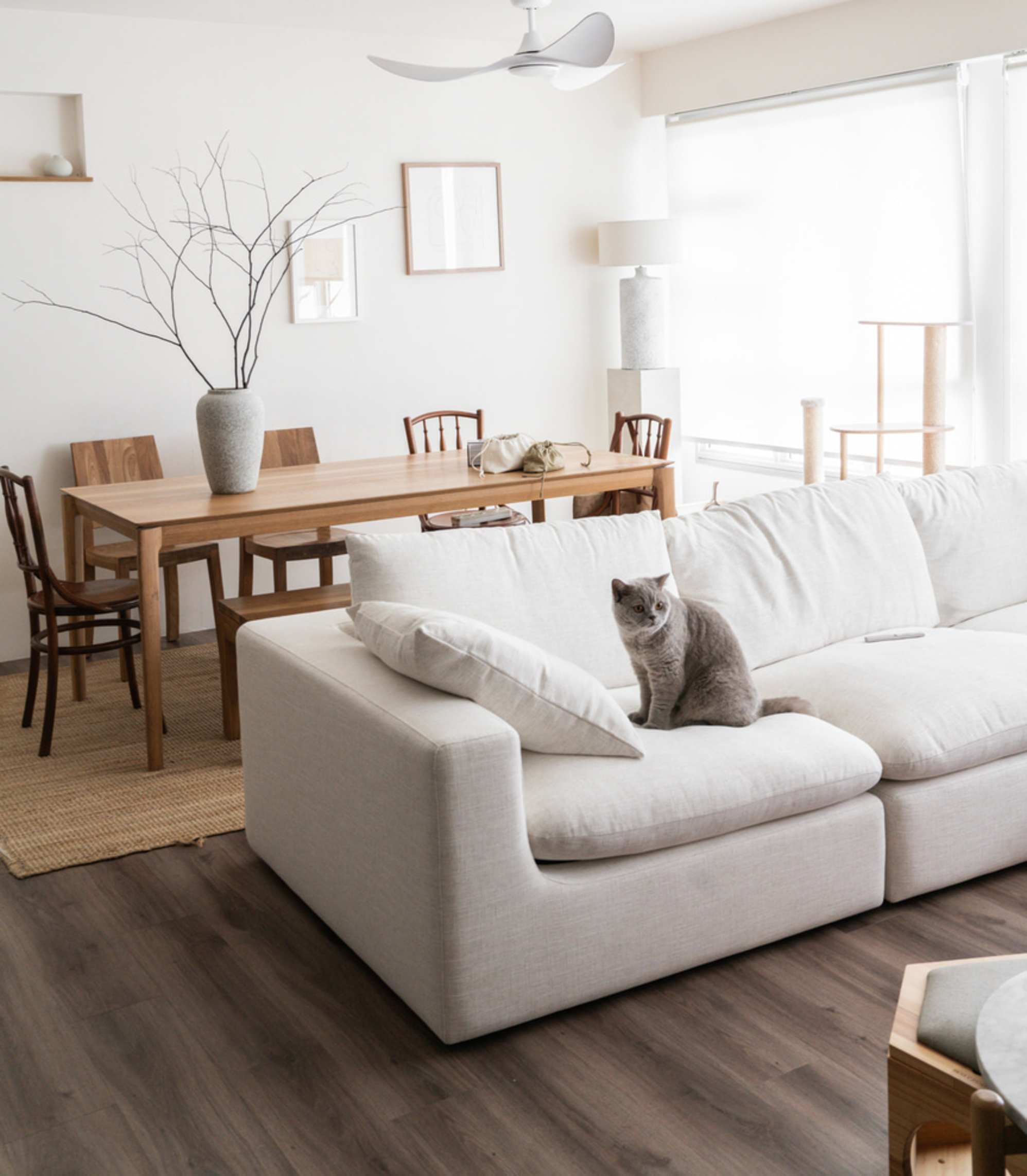
The Peri Coffee Table
Picture credits: @rumahpunggol
The Peri Coffee Table
Picture credits: @rumahpunggol

Choosing a couch that earns its place
Open-concept rooms are unforgiving precisely because they are so exposed. Every decision is visible from multiple angles, in multiple contexts, at multiple times of day.
Start with function. Scale to the zone. Consider the back as seriously as the front. Choose materials that live as hard as you do. When you approach an open floor plan that way, the best couches for open floor plan homes become less about chasing trends and more about shaping how daily life flows through the space.
Frequently asked questions about open-concept living rooms
How do I arrange a sectional sofa in an open floor plan?
Treat the modern sectional sofa as a zone divider, not a wall-hugger. Use its L or U shape to separate the lounge from the dining area, with the longer arm acting as the visual line between them. Leave breathing room on at least one side, and anchor the seating with a rug big enough to sit under the front legs.
What type of couch is best for an open-concept living room or open floor plan?
There’s no single best couch type for an open-concept living room. The right choice depends on what the job it’s doing: anchoring the lounge, dividing it from the dining area, or facing a focal point. Sectionals and modular sofa configurations tend to work hardest in open floor plans because they define zones without needing a wall to lean against.
What is the 2/3 rule for a living room?
The 2/3 rule is a proportion guideline. The couch should occupy roughly two-thirds of the wall or zone it sits against, and the coffee table should be about two-thirds the length of the couch. In an open-concept space, apply it to the lounge zone rather than a wall.
