
What Size Mirror Do You Actually Need for Your Room?
You've found the mirror. It's beautiful in the photo, beautiful in the box, and somehow, underwhelming the moment you place the mirror on your wall. Too small, and it hovers awkwardly like it lost its purpose. Too big, and suddenly your console looks like it’s being upstaged in its own home.
This is the quiet design decision most people underestimate. What size mirror you choose doesn’t just affect the wall; it reshapes how the entire room feels. Get it right, and the space opens up. Get it wrong, and you’ll keep rearranging everything else, trying to fix a problem that started here.
Let’s make sure you don’t have to guess.
Standard mirror sizes (and what they’re actually good for)
Before you measure anything, it helps to understand the baseline. Most mirror sizes fall into predictable ranges, and each one plays a different role in a room.
Here’s a quick guide to the standard mirror sizes:
Small (12" to 24"): Best for tight, functional spaces like entryways or powder rooms, or above a single bathroom sink. Ideal for renters, smaller apartments, or anyone working with tight wall space. These are your quick-check mirrors, not your statement pieces.
Medium (24" to 36"): The most versatile range. Works above dressers, console tables, and in shared bathrooms. If you’re unsure where to start, this is usually it.
Large (36" to 48"): Where presence starts to matter. These work beautifully in dining rooms, vanities, above a long console, or as a living room focal point. Best for homeowners ready to give a wall a real focal point.
Oversized and full-length (48" to 72"+): Made for bedrooms, dressing corners, and expansive walls. This is less about decoration and more about daily life. If you use your mirror every morning, this is the category that earns its keep.
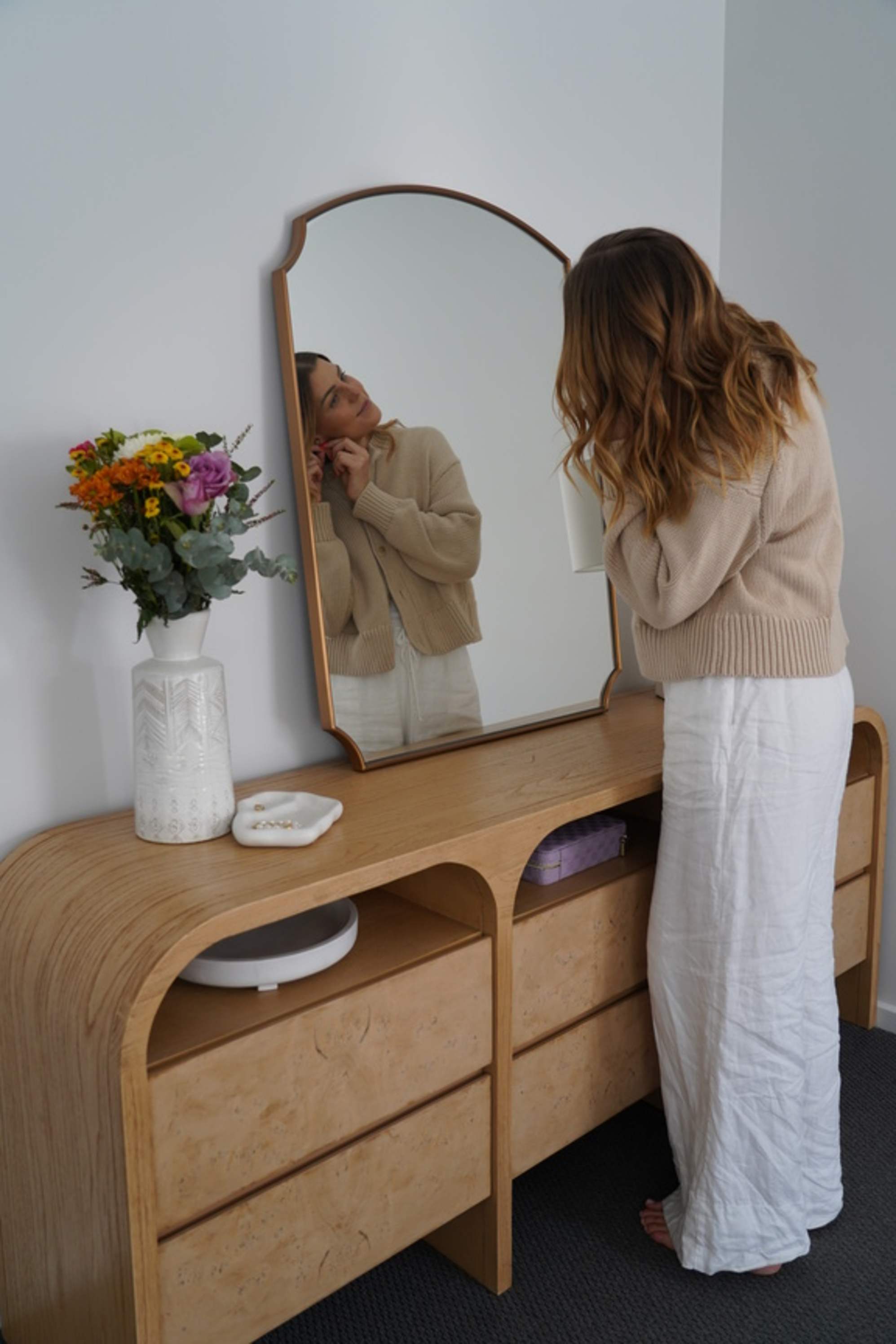
The Aria Wall Mirror
Picture credits: @hayleyjconnor
The Aria Wall Mirror
Picture credits: @hayleyjconnor
The Nadine Floor Mirror
Picture credits: @lovinglittlehalls
The Nadine Floor Mirror
Picture credits: @lovinglittlehalls

How do I know what size mirror to get?
Measure the wall first, not the mirror
Here’s the rule most people skip. Your mirror should take up about two-thirds of the wall width it sits on. This keeps it feeling intentional without overwhelming the space.
Smaller than that, and it starts to look misplaced
Larger, and it risks dominating everything around it
This is where mirror measurements matter more than aesthetics. A beautiful mirror in the wrong size will never feel right, no matter how good it looked in the showroom.
Be mindful of furniture and decor coordination
A mirror rarely lives in isolation. It hangs above something, reflects something, and shares a wall with something else.
The general guideline is that a wall mirror should be roughly two-thirds to three-quarters the width of the furniture beneath it.
Above a dresser, it should echo the width without matching it exactly
Above a sofa, it should feel like part of the composition, not an afterthought
Behind a bed, it should respect the scale of the frame
Think about functionality
Be honest about what you actually need the mirror to do. A statement piece in the living room can be more about visual weight than reflection. On the other hand, a bedroom or bathroom mirror has a job. If you're getting ready in front of it daily, it needs to function without effort.
Ask yourself:
Do you need to see your full outfit?
Or just your face while getting ready?
Will more than one person use it?
Function will dictate your standard mirror height and width faster than style ever will. And if a mirror interrupts your morning routine, you’ll notice it every single day.
The Serena Floor Mirror
Picture credits: @mensweardog
The Serena Floor Mirror
Picture credits: @mensweardog

The Aria Round Wall Mirror
Picture credits: @halfway_wholeistic
The Aria Round Wall Mirror
Picture credits: @halfway_wholeistic
Leave breathing room
A mirror needs space around it in the same way a sofa does. If pushed too close to the ceiling, doorframe, or adjacent decor, it stops feeling like a deliberate choice and starts feeling like an accident.
Aim for at least 4 to 6 inches of clearance around the mirror whenever possible. This margin is subtle, but it’s what separates a wall that feels styled from one that feels crowded. You don’t notice it immediately, but you feel it.
Use scale to shape how the room feels
Scale isn't just about fit. It's about presence. The size of your mirror doesn’t just fit the space, it changes it.
A slightly oversized mirror can make a small room feel taller and brighter
A smaller mirror in a large room can feel lost and uncertain
If you want the mirror to be the focal point in the room, lean toward a larger one with height. If it's a supporting player, scale it down to the piece beneath it and let it stay quiet.
This is the difference between a mirror that exists and one that transforms.
A mirror that earns its place
The right mirror doesn’t demand attention. It earns it quietly. When you get the size right, you stop noticing the mirror as a separate object and start noticing what it does to the space: more light, more depth, and more breathing room.
That’s the goal. Not just to fill a wall, but to finish a room in a way that feels effortless to live with every day.

Frequently asked questions about what size mirror you need
What size mirror makes a room look bigger?
Larger mirrors tend to do more for the illusion of space, especially when they're positioned to reflect natural light or a focal point in the room. As a guide, anything that fills roughly two-thirds of the wall, or stretches from floor to near-ceiling, will make the biggest visual difference.
How wide should a mirror be over a 48" vanity?
A good rule of thumb is to size the mirror to about 70 to 80 percent of the vanity width, which puts you in the 32 to 40 inch range for a 48 inch vanity. That ratio keeps the mirror grounded to the vanity below without crowding the wall space on either side.
What shape mirror over the fireplace?
Round and arched mirrors tend to work best over a fireplace, since the soft curves balance the strong horizontal line of the mantel. If your space leans more traditional or you want a sharper, more architectural feel, a tall rectangular mirror is a reliable second choice.
