
How Big Should a Coffee Table Be? A Simple Size Guide
You've measured the sofa twice. You've eyeballed the rug. Maybe you've even held up a tape measure in the middle of the living room with no real sense of whether that coffee table will feel right in your living room (or swallow it whole).
Most coffee table sizing guides tell you to pick something "proportional". Helpful in theory, less so when you're staring at dozens of coffee tables that all look roughly the same.
We’ll cover the actual answers in this guide: the standard dimensions for a coffee table, including the ideal length, width, height, and spacing based on your sofa, room size, and how you use your living room.
Why the size of your coffee table matters
A coffee table sits right at the centre of your living room. It needs to be close enough for your morning coffee, spacious enough for movie-night snacks, and positioned so you can walk around it without bruising a shin.
When the dimensions are off, the whole room feels slightly awkward. A table that's too small disappears beside the sofa. One that's too large makes the room feel cramped, no matter how beautiful it is.
The good news? A few simple measurements take the guesswork out of finding the right coffee table.
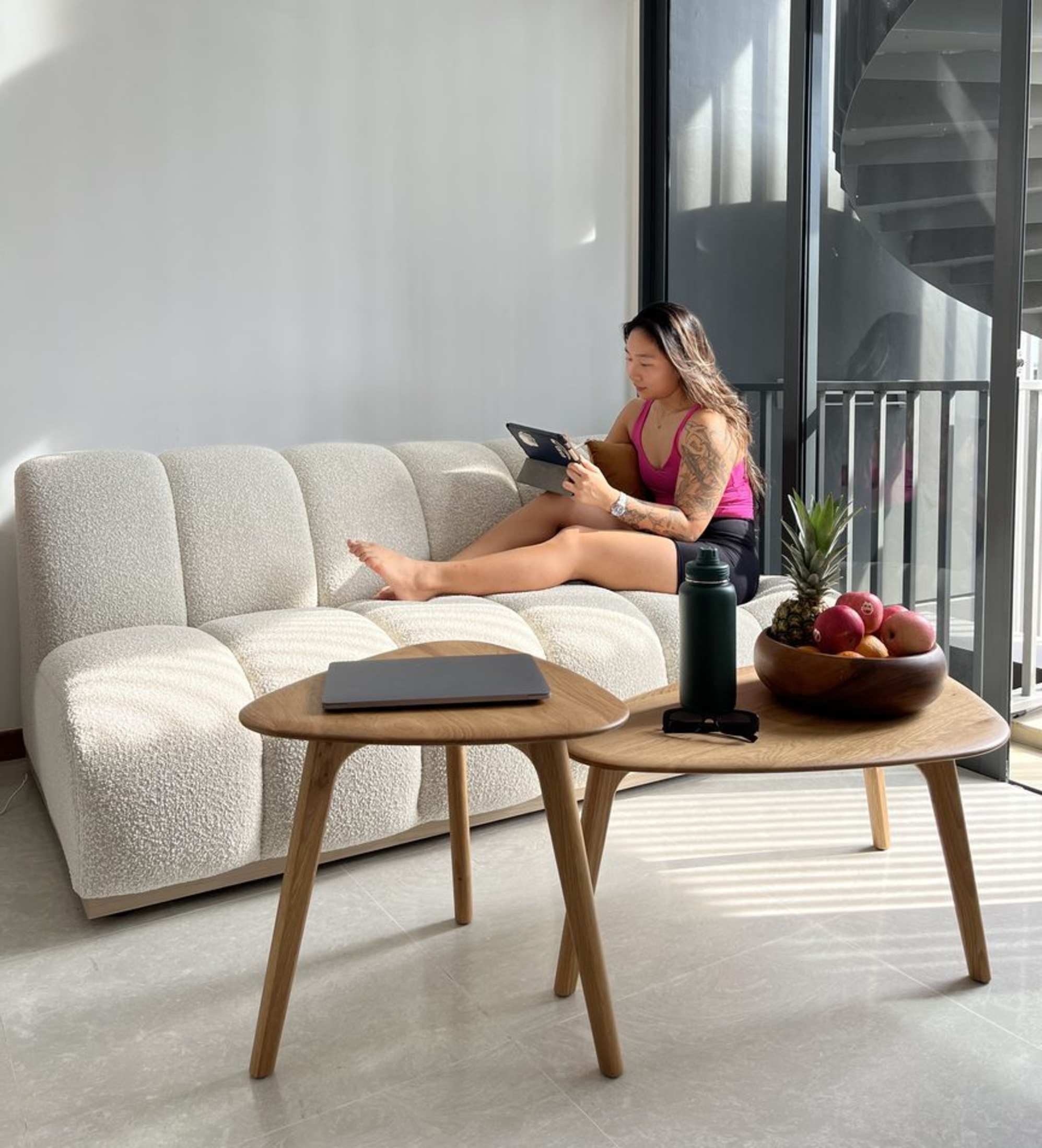
The Hugg Rectangular Nest of Coffee Table
Picture credits: @homewithtohs
The Hugg Rectangular Nest of Coffee Table
Picture credits: @homewithtohs
The Mori Coffee Table
Picture credits: @twopotatoesinasack
The Mori Coffee Table
Picture credits: @twopotatoesinasack
The four dimensions to get right before you buy
Before comparing materials, finishes, or shapes, focus on these four measurements:
Length: How long the table should be compared to your sofa
Width: How deep the tabletop should be
Height: How tall it should sit beside your sofa
Clearance: How much walking space to leave around it
Get these four right first and almost every other design decision becomes much easier, especially if you have a small living room.
How long should a coffee table be?
If you're wondering how big a coffee table should be compared to a sofa, the easiest rule is also the one interior stylists use most often. Aim for a coffee table that's around two-thirds the length of your sofa.
This creates visual balance while making the table easy to reach from every seat. It also avoids the two most common mistakes: choosing something so short it looks disconnected, or so long it competes with the sofa itself.
Here's a guide on coffee table size by sofa type:
| Sofa length | Recommended coffee table length |
|---|---|
| Under 180 cm (71 in) (compact 2-seater) | 89–119 cm (35–47 in) |
| Around 200 cm (79 in) (standard 3-seater) | 99–132 cm (39–52 in) |
| Around 220 cm (87 in) (large sofa or compact corner sofa) | 109–147 cm (43–58 in) |
| 239 cm (94 in) and above (oversized corner sofa) | 119–160 cm in (47–63), or use two nesting tables |
How wide should a coffee table be?
The depth of your coffee table depends largely on the sofa you're pairing it with. If you have a large L-shaped sofa, you'll want a deeper table to fill the extended space and give anyone on the chaise side somewhere to reach for their cup.
A standard sofa pairs comfortably with a table between 45 and 76 cm wide, while corner sofas and chaise sofas often benefit from a deeper tabletop so everyone can reach drinks or books without leaning across the room.
Beyond the sofa, your room itself sets a ceiling on width. Here’s a general guide for coffee table dimensions relative to room size:
| Room size | Recommended coffee table width |
|---|---|
| Small (under 14 m² / 150 sq ft) | 45–60 cm (18–24 in) |
| Medium (14–23 m² / 150–250 sq ft) | 60–75 cm (24–30 in) |
| Large (23+ m² / 250+ sq ft) | 75–90 cm (30–36 in), or match to an L-shaped sofa's depth |
If you have a standard two- or three-seater sofa, width matters less. What matters more is surface area, enough to comfortably hold drinks, snacks, and whatever book you're currently pretending you'll finish.
How tall should a coffee table be?
Height is where most people guess, and where most guesses are wrong.
Most coffee tables sit slightly lower than the sofa seat, and the standard coffee table height range is about 5 to 10 cm lower than your cushions. Go higher, and the table looks like it's trying too hard. Go lower, and you'll find yourself hunching to reach your coffee.
How tall your coffee table should be also depends on what you usually do:
| How you use it | Recommended coffee table height |
|---|---|
| Everyday lounging | 40–45 cm (16–18 in) |
| Low-profile lounge seating | 25–35 cm (10–14 in) |
| Eating, working or board games | 45–55 cm (18–22 in) |
If you have a particularly high sofa, don't automatically choose the tallest coffee table available. Glass tops or slim metal legs can add visual height without making the room feel bulky, while lower sofas pair beautifully with solid timber designs that feel grounded and relaxed.
How much space should you leave around a coffee table?
Even a perfectly sized coffee table won't feel right if it's squeezed into the room.
Leave about 35 to 45 cm between your sofa and coffee table. This gives you enough room to stretch out comfortably while still reaching your drink without leaning forward. You'll also want a similar clearance around the remaining sides of the table so people can move naturally through the space.
Think of your coffee table as the living room's roundabout. Everyone should be able to move around it without slowing down.
Coffee table sizing at a glance
If you only remember four measurements, make them these:
| Coffee table dimensions | Rule of thumb |
|---|---|
| Length | About two-thirds the length of your sofa |
| Width | 45–90 cm (18–36 in), depending on room size |
| Height | Around 5–10 cm (2–4 in) lower than your sofa seat |
| Clearance | Leave 35–45 cm (14–18 in) around all sides |
How to coordinate your coffee table with the rest of your living room
Once you've landed on the right dimensions, styling becomes much more intuitive because every furniture piece has room to breathe. A few things to size and style around:
Rugs: A rug should extend to at least 15 to 25 cm beyond each side of your coffee table, so the table is anchored to the rug rather than floating on top of it.
Armchairs: Keep armchairs close enough to the table that a hand can reach a drink without a stretch, generally within 35 to 45 cm.
TV stands: A low-profile coffee table pairs naturally with a media console at a similar height, so the eye reads them as one continuous line rather than two competing pieces.
Shape and silhouette: A curvy sofa calls for a round or oval table to match its non-perpendicular lines. A sharper, more angular sofa works better with a rectangular or square top.
Material and era: Metal legs, dark wood tops, and mid-century influences suit a retro-leaning room. A lighter, brighter table lends a more modern space some Scandi-cool.
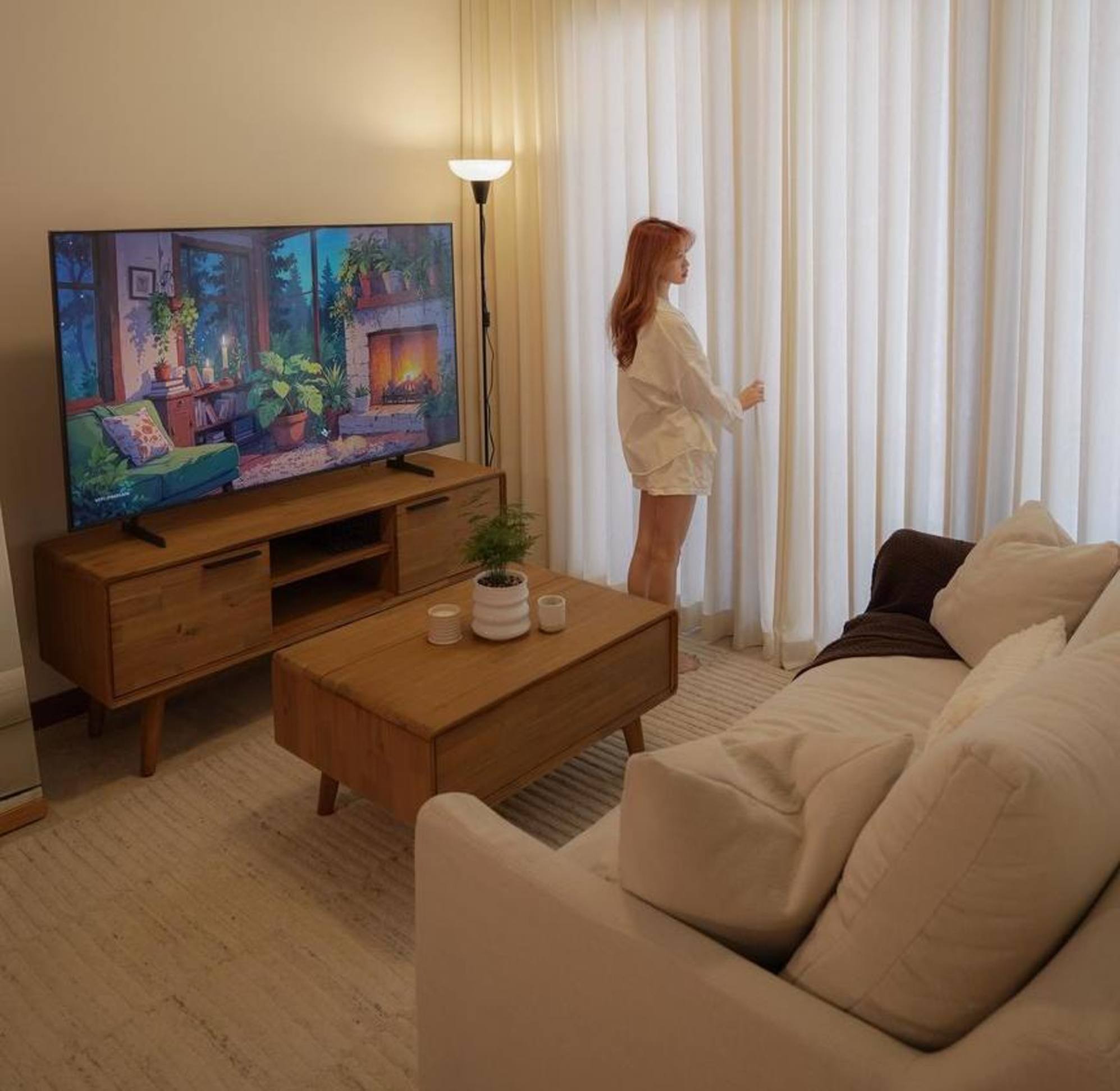
The Vincent Oak Nesting Coffee Table
Picture credits: @movewithcarissa
The Vincent Oak Nesting Coffee Table
Picture credits: @movewithcarissa
The coffee table that actually fits
The right coffee table isn't necessarily the one with the most beautiful finish or the boldest silhouette. It's the one that quietly gets everything right.
The right length keeps your living room balanced. The right width gives everyone a place to set down a cup. The right height feels effortless every time you reach for the remote. And the right spacing means you'll never have to sidestep your way across the room.
Start with the measurements, then choose the material, shape, and style that feels most like home. When the dimensions work, everything else falls into place.

Frequently asked questions about standard coffee table dimensions
What’s the best size for a coffee table?
The best size is about two-thirds the length of your sofa, with enough width to suit your room size and at least 35 to 45 cm of clearance on every side. Beyond that, it comes down to how you actually use the table day to day.
What type of coffee table makes a room look bigger?
A table with exposed legs and a lighter material, glass, light wood, or a slim metal frame, tends to make a room feel more open. Round or oval shapes also help traffic flow better in tighter spaces than sharp corners do.
Can a coffee table be too big?
Yes. A table that crowds out walking space or overwhelms your sofa's proportions will make a room feel smaller, not more finished. If you can't comfortably walk around it, it's oversized for the space.
